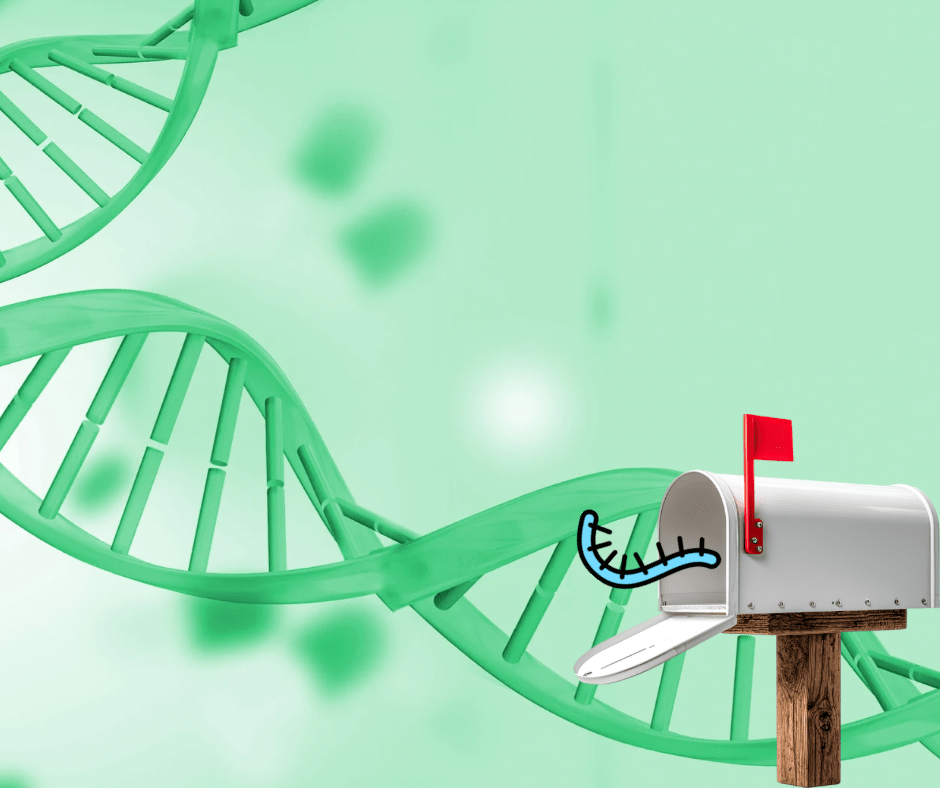
While Meg Ryan and Tom Hanks have nothing to do with mRNA, mRNA has everything to do with how your body sends mail.
Long before it was politicized, debated, or turned into a household acronym, mRNA was simply doing its job inside your body, every second of every day, without asking for attention or credit.
So what is mRNA, really? And how did it become one of the most important tools in modern medicine?
Let’s rewind.
The Original Messenger
Inside every one of your cells is DNA: the master instruction manual. But DNA never leaves the nucleus (protected middle of your cell.) It’s too valuable, too central, too protected.
Instead, your body uses a courier.

Messenger RNA, or mRNA, is the middleman. When your body needs to make something (like a protein), DNA writes a temporary note. That note is mRNA. It carries instructions from the nucleus to the rest of the cell, where proteins are built.
Then it disappears.
mRNA is intentionally fragile. It doesn’t linger. It doesn’t alter DNA. It delivers a message and exits the scene. This is biology’s version of a self-destructing text message.
And that fragility is exactly what makes it powerful.
A Radical Idea (That Almost Failed)
In the 1970s and 80s, scientists had a bold idea: What if we could use mRNA to teach the body how to protect itself?
Instead of injecting weakened viruses or virus pieces, what if we simply gave the body the instructions to make it and let it do the rest?
The idea was elegant. The execution was viewed with skepticism.
Early mRNA was unstable, easily destroyed, and triggered aggressive immune reactions. Many scientists walked away from it entirely. Funding dried up. Journals lost interest.
But a handful of researchers didn’t.
One of them was Nobel prize winner, Katalin Karikó, who spent decades trying, and failing, to convince the scientific world that mRNA could work. She faced rejection after rejection, lost funding, and was demoted at one point. Still, she kept asking the same question:
What if the problem isn’t mRNA itself, but how we’re delivering it?

A Fatty Solution
The breakthrough came in the early 2000s.
Scientists discovered that slightly modifying mRNA could help it slip past the immune system without setting off alarms. Pair that with lipid nanoparticles, tiny fat bubbles that protect mRNA and help it enter cells, and suddenly, the impossible became possible.
mRNA could survive long enough to deliver its message.
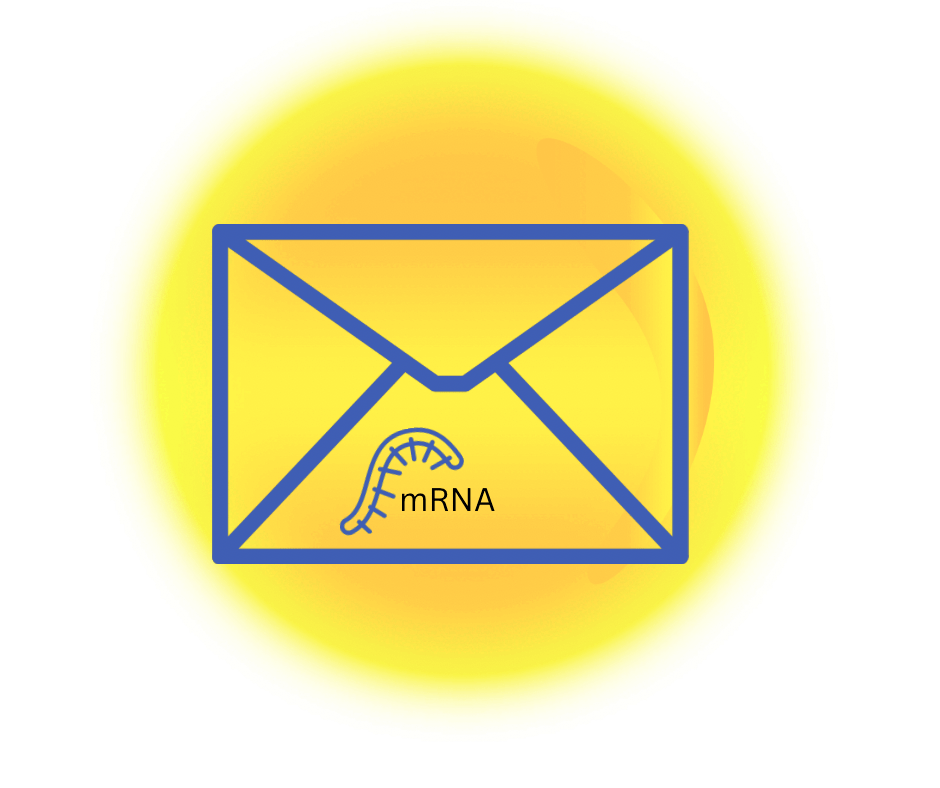
This didn’t just matter for vaccines. Researchers immediately saw potential for cancer treatment, autoimmune diseases, and genetic disorders. mRNA could be rewritten, customized, updated. It wasn’t a single drug, it was a platform.
But science moves carefully. Trials take years. Progress is incremental.
Until it wasn’t.
Feeling the Need for Speed
When COVID-19 emerged, mRNA didn’t have to be invented. It was already waiting in the wings.
Scientists didn’t need to grow the virus or weaken it. Once the genetic sequence was known, they could design an mRNA message in days. That message instructed cells to make a harmless piece of the virus, enough for the immune system to learn, recognize, and remember.
No live virus. No permanent changes. Just instructions, delivered and deleted.
The speed shocked the public. But for scientists, it wasn’t magic, it was momentum. Decades of quiet, overlooked work finally had its moment.
What mRNA Vaccines Don’t Do
– mRNA vaccines NEVER enter the nucleus.
– They NEVER interact with DNA.
-They DO NOT stay in the body.
They DO what mRNA has always done: deliver instructions, then break down.
Your immune system does the rest.
That’s it.
Why This Matters Beyond Vaccines
The real story of mRNA isn’t just about COVID.
It’s about a new way of thinking about medicine, one that works with the body instead of around it. One that can be rapidly adapted, personalized, and refined.
Cancer vaccines.
Universal flu shots.
Treatments for rare genetic diseases.
These aren’t futuristic fantasies. They’re already in development.
mRNA isn’t new. It’s just finally being heard.
Citations
Bansal, A. (2023). From rejection to the Nobel Prize: Karikó and Weissman’s pioneering work on mRNA vaccines, and the need for diversity and inclusion in translational immunology. Frontiers in Immunology, 14, 1306025. https://doi.org/10.3389/fimmu.2023.1306025
https://pmc.ncbi.nlm.nih.gov/articles/PMC10663363/
Beyrer, C. (2021, October 6). The long history of mRNA vaccines. Johns Hopkins Bloomberg School of Public Health. https://publichealth.jhu.edu/2021/the-long-history-of-mrna-vaccines
https://publichealth.jhu.edu/2021/the-long-history-of-mrna-vaccines
National Human Genome Research Institute. (2026, January 30). Messenger RNA (mRNA). Genome.gov. https://www.genome.gov/genetics-glossary/Messenger-RNA-mRNA


 Think Like a Scientist
Leave a comment